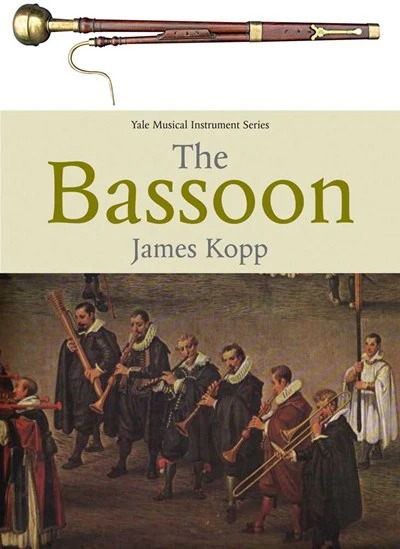
The Bassoon
An authoritative account of the 500-year history of the bassoon, with new research findings and dozens of rare illustrations
This welcome volume encompasses the entire history of the bassoon, from its origins five centuries ago to its place in twenty-first-century music. James Kopp draws on new archival research and many years’ experience playing the instrument to provide an up-to-date and lively portrait of today’s bassoon and its intriguing predecessors. He discusses the bassoon’s makers, its players, its repertory, its myths, and its audiences, all in unprecedented detail.
The bassoon was invented in Italy in response to the need for a bass-register double-reed woodwind suitable for processionals and marching. Composers were quick to exploit its agility and unique timbre. Later, during the reign of Louis XIV, the instrument underwent a major redesign, giving voice to its tenor register. In the early 1800s new scientific precepts propelled a wave of invention and design modifications. In the twentieth century, the multiplicity of competing bassoon designs narrowed to a German (or Heckel) type and a French type, the latter now nearly extinct. The author examines the acoustical consequences of these various redesigns. He also offers new coverage of the bassoon’s social history, including its roles in the military and church and its global use during the European Colonial period. Separate historical chapters devoted to contrabassoons and smaller bassoons complete the volume.
An authoritative account of the 500-year history of the bassoon, with new research findings and dozens of rare illustrations
This welcome volume encompasses the entire history of the bassoon, from its origins five centuries ago to its place in twenty-first-century music. James Kopp draws on new archival research and many years’ experience playing the instrument to provide an up-to-date and lively portrait of today’s bassoon and its intriguing predecessors. He discusses the bassoon’s makers, its players, its repertory, its myths, and its audiences, all in unprecedented detail.
The bassoon was invented in Italy in response to the need for a bass-register double-reed woodwind suitable for processionals and marching. Composers were quick to exploit its agility and unique timbre. Later, during the reign of Louis XIV, the instrument underwent a major redesign, giving voice to its tenor register. In the early 1800s new scientific precepts propelled a wave of invention and design modifications. In the twentieth century, the multiplicity of competing bassoon designs narrowed to a German (or Heckel) type and a French type, the latter now nearly extinct. The author examines the acoustical consequences of these various redesigns. He also offers new coverage of the bassoon’s social history, including its roles in the military and church and its global use during the European Colonial period. Separate historical chapters devoted to contrabassoons and smaller bassoons complete the volume.
Original: $50.00
-65%$50.00
$17.50Description
An authoritative account of the 500-year history of the bassoon, with new research findings and dozens of rare illustrations
This welcome volume encompasses the entire history of the bassoon, from its origins five centuries ago to its place in twenty-first-century music. James Kopp draws on new archival research and many years’ experience playing the instrument to provide an up-to-date and lively portrait of today’s bassoon and its intriguing predecessors. He discusses the bassoon’s makers, its players, its repertory, its myths, and its audiences, all in unprecedented detail.
The bassoon was invented in Italy in response to the need for a bass-register double-reed woodwind suitable for processionals and marching. Composers were quick to exploit its agility and unique timbre. Later, during the reign of Louis XIV, the instrument underwent a major redesign, giving voice to its tenor register. In the early 1800s new scientific precepts propelled a wave of invention and design modifications. In the twentieth century, the multiplicity of competing bassoon designs narrowed to a German (or Heckel) type and a French type, the latter now nearly extinct. The author examines the acoustical consequences of these various redesigns. He also offers new coverage of the bassoon’s social history, including its roles in the military and church and its global use during the European Colonial period. Separate historical chapters devoted to contrabassoons and smaller bassoons complete the volume.